
How to make an original LEGO product line
Read the full story →
To start you will need to learn a new language. LEGOspeak. Products are models. A group of models are a theme. An original product line such as Atlantis is a playtheme.
LEGO products have always been designed in Billund, Denmark — but the way they were made changed dramatically. This is the beginning of a series that looks into that little-known, very niche, highly obscured process that made the world’s favorite building sets.
The entire model was based on conflict orientation. Powerful shooting weapons would be required on the submarines. Cockpits would need to be airtight.
The old guard
Early designers of LEGO models in the 80s were essentially untrained hobbyists, not formally trained designers. Most of the old guard were retired in the late 90s and replaced by a new, younger, English-led design-school generation.
In those early days of building playthemes, small teams spent 2–3 years creating a full line of 15 or 20 models. At the end of that period a marketing executive would browse the line, pick 6–8 models as an assortment, and they would be finalized for the marketing phase of development.
In&Out vs. Big Bang
2005–2010 were defined by two types of original Playtheme: In&Out or Big Bang. Vikings and Castle lines were treated as one-off lines to fill out the portfolio during these years. Space was largely killed by the contract terms on Star Wars.
New playthemes were required. Power Miners was one of the first real Big Bangs to be born, followed by Atlantis. Big Bangs included content to tell more story with named characters.
The playtheme puzzle
In the case of Atlantis, a methodology was used to align and improve the iconic features of the models called the playtheme puzzle. This literal set of puzzle pieces formed the who, what, how and where — with one key feature in the middle: the reason for fight.
The entire model was based on conflict orientation. Powerful shooting weapons would be required on the submarines. Cockpits would need to be airtight. A clear color scheme for the good guys and the bad guys was required to keep the conflict clear.
The model that didn’t make it
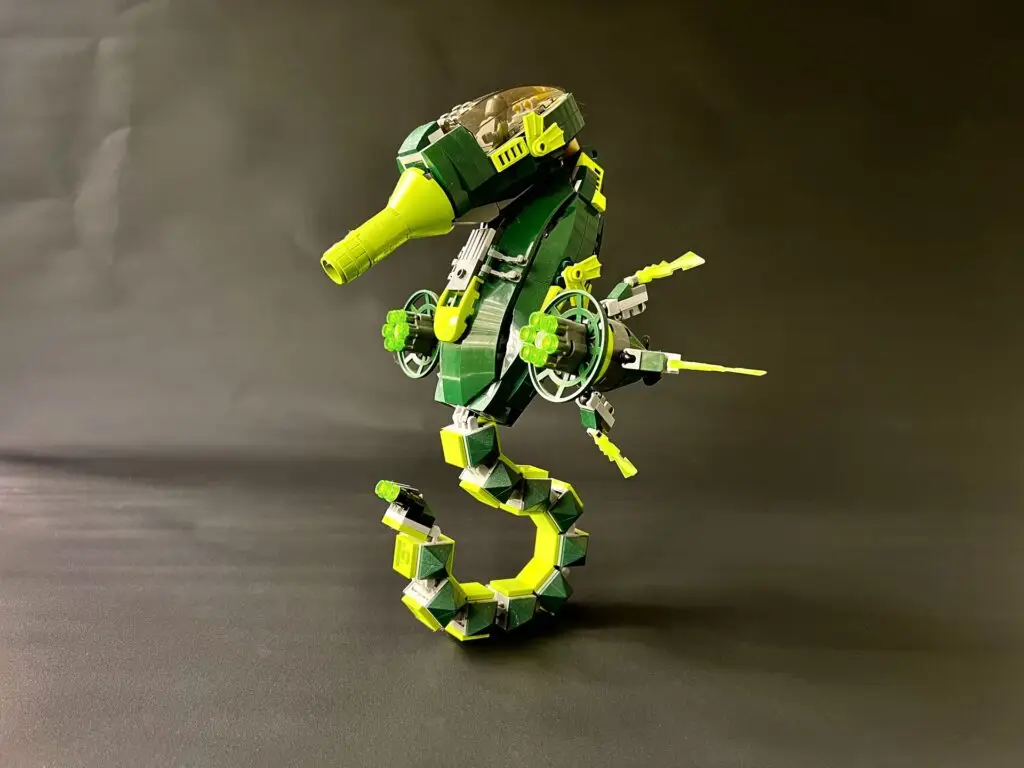
The Seahorse Submarine concept may have inspired the Atlantis product line — but it did not meet the requirements. It was top-heavy. It was hard to build. It was too abstract. And it was not the red hero submarine that would commercially take the heroes deep underwater.
Provenance
This model was saved by the original creators and handed over — literally and figuratively — to the incoming NINJAGO leadership as a torch of creativity that bears responsibility. Private property as of 2011.
One comment
Let’s see more.